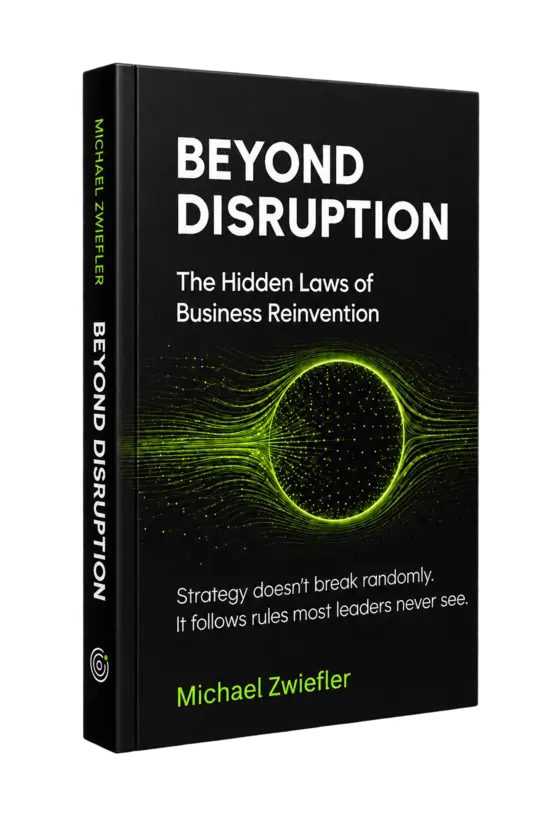
A book by Michael Zwiefler
BEYOND
DISRUPTION
The Hidden Laws of
Business Reinvention
Strategy doesn’t break randomly. It follows rules most leaders never see.

The observation
Why do capable leaders, running capable companies, so often fail to change in time?
Not because they didn’t see it coming. Most did. The companies struggling hardest today are often not the ones that failed to see disruption coming, but the ones that saw it clearly and still could not move.
Same heritage. Same barrier. Two outcomes.
Kept defending the business it knew, because film was still more profitable in the short term. It collapsed into bankruptcy.
Asked what it actually knew how to do, and jumped into industries it had never been in, while film was still profitable.
The difference was not information.It was the ability to move.
The idea
Businesses aren’t machines to be managed. They are systems that obey laws.
Before strategy, before execution, before transformation initiatives, there are laws that govern how systems behave. Left alone, organizations drift towards disorder. Under pressure, they resist change. At critical moments, they shift abruptly. These patterns are not random. They follow principles studied for decades in physics and complex systems.
This is why many transformations fail. Not because the strategy was wrong. Not because execution was weak. But because the organization was working against the dynamics of the system itself.
Transformation programme
A cycle that returns to where it started
Reinvention operating system
A spiral that starts higher every turn
Part II · The Hidden Forces of Strategy
Ten laws. None of them are metaphors.
Ten principles from physics and complex systems that describe how organizations behave under pressure, growth and disruption. Turn a card over to see the law’s line.
System pressure & decay forces
Why systems resist change and accumulate fragility
Perception & decision forces
How leaders interpret reality and navigate uncertainty
Transformation & transition forces
How systems evolve, experiment and shift between states
System connectivity & amplification forces
How change propagates, amplifies and becomes systemic
A system evolves through five connected dynamics
Constantly shaping and reshaping itself
Systems drift, are misread, explore possibilities, shift nonlinearly, and are ultimately shaped by what they reinforce.
Inside the book
Six parts. From the laws to the leader.
Disruption
When change stops being an event and becomes the systemWhy disruption is now a permanent condition, and why successful organizations become structurally resistant to the change they need.
Read the teaser →IIPart IIThe Hidden Forces of Strategy
When strategy stops being intuition and becomes physicsTen laws that explain why complexity accumulates, why success becomes a trap, and why change arrives suddenly.
Read the teaser →IIIPart IIIThe Reinvention Operating System
When reinvention stops being a project and becomes an operating systemFour systems that sense, generate, commit and evolve, and the DNA that makes reinvention repeatable.
Read the teaser →IVPart IVWhere Reinvention Becomes Real
When the operating system stops being a concept and becomes a structureFive integrated models for redesigning how value is created and how the enterprise is configured.
Read the teaser →VPart VAdaptive Strategy
When advantage stops being stable and starts requiring motionWhat strategy becomes when advantage decays faster than it can be defended.
Read the teaser →VIPart VIThe Adaptive Mind
When adaptation stops being organizational and becomes personalNine leadership postures, drawn from the same ten laws and turned on the leader’s own judgement.
Read the teaser →Running through the book
One bank, relearning how to survive its own success.
Vossberg Bank AG is a mid-sized Frankfurt bank with a proud trade-finance heritage. It is fictitious, but built from real engagements. Its story unfolds in short interludes at the end of each chapter, and the ten laws start looking like decisions a real institution has to make, under real pressure.
On a humid afternoon in Singapore, a relationship manager at a mid-sized German bank’s Asia subsidiary lost a trade-finance mandate she had held for eleven years. A competitor had onboarded the client’s new entity in four days. Her bank had quoted six weeks. Nobody in Frankfurt heard about it that week.
From “A First Tremor”, the Vossberg File
Across the business in 80 challenging questions
Questions your board should be asking
Not a checklist, and not a search for reassuring answers. Questions designed to interrupt familiar reasoning, and to expose the assumptions that performance reviews leave untouched.
Ten themes, eight questions each
Three examples
For founders
Building a company while its future is still taking shape?
The book’s central ideas, turned into the questions founders need to ask: from ambition, product-market fit and asymmetric advantage to growth, resource allocation, risk and the evolving role of the founder. A concise field guide, free by email.
Get the founders’ guideArticles
Business reinvention, applied
Regular articles that apply the laws to what is happening in business now.
Calm is not evidence
Why the most dangerous moment for a leader is the one in which nothing seems wrong, and four questions to ask when it arrives.
Read →
The next article
Free to read, no sign-up.
The next article
Free to read, no sign-up.

The author
Michael Zwiefler
Michael Zwiefler is the founder of origin42, a venture and advisory business with deep AI expertise. He brings more than twenty-five years of experience advising organizations through profound change, first as a senior partner and managing director at leading consulting firms, and later as General Manager of a billion-dollar technology business unit. His work has included designing and executing major reinvention initiatives across Asia, Europe, the Middle East and the US.
More about the author →Strategy doesn’t break randomly.Learn the rules it follows.
Paperback · ISBN 978-3-200-11464-7
Buy on Amazon